This symposium series presents an intervention of art and activism promoting dialogue and understanding within the diverse and sometimes divided Viennese society—and beyond, regarding Palestine and Israel.In the wake of deepening divisions, dehumanization, and violence—from the ethnic cleansing in 1947, throughout the years of occupation, and reciprocal violence culminating in the Hamas massacre on October 7 and the ongoing genocide in Gaza—these events will explore possible paths to accountability and reconciliation by engaging experts, artists, and representatives from human rights and civil society organizations across the region and Europe.
The first event in the series, Dialogue and Partnership, will examine how to build meaningful conversation and cooperation under conditions of structural inequality, occupation, segregation, and power imbalances.
Common Ground – Deconstructing Walls is a four-part symposium series, with Dialogue and Partnership marking the beginning.
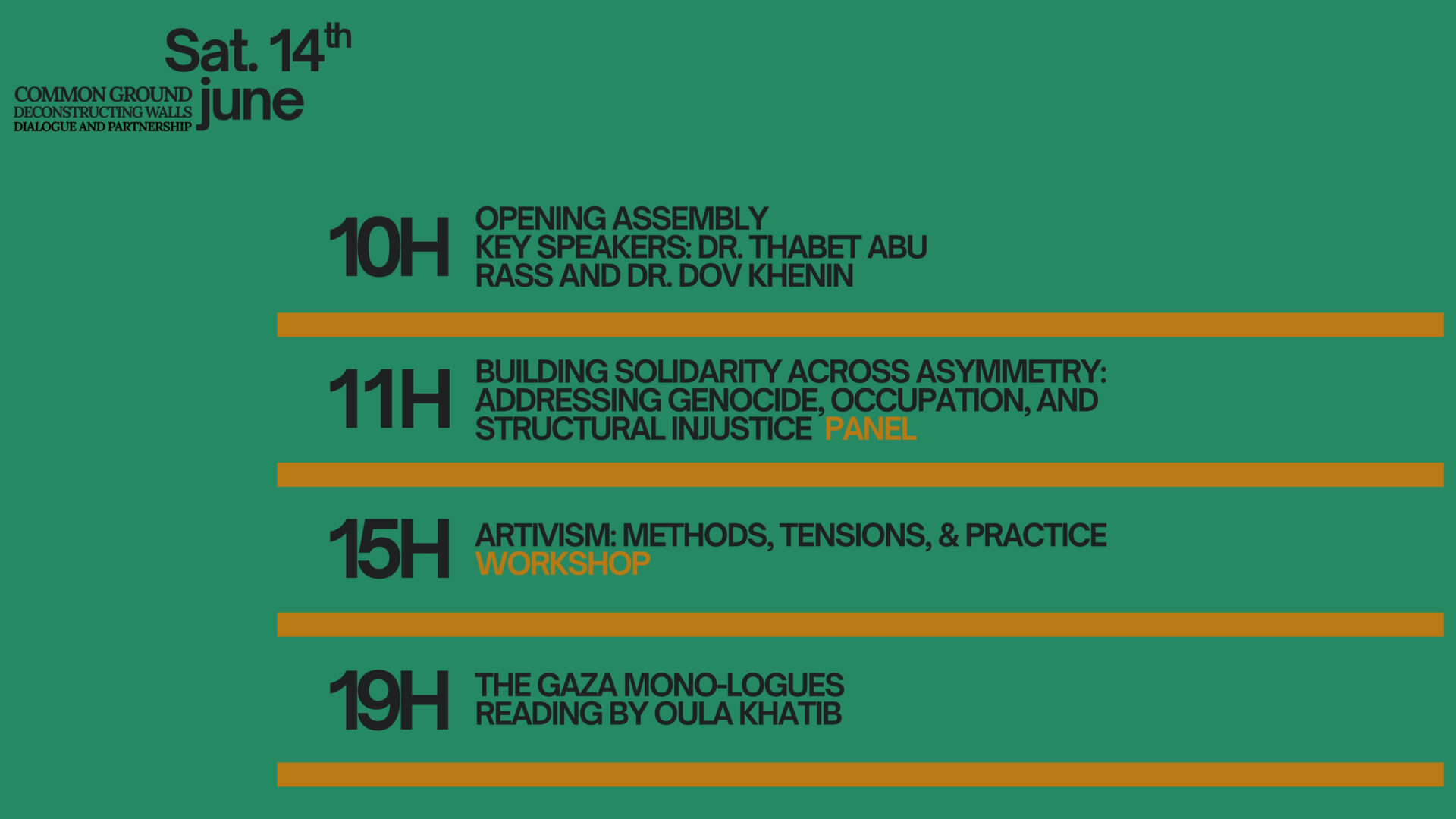
10:00 Opening Assembly
We begin with a moment of silence for the victims of the ongoing war, followed by an introduction to the symposium’s theme: dialogue and partnership. As the first in a series of four events, this assembly sets the stage for conversations on how art and activism can drive accountability, reconciliation, and a shared future beyond division.
Key speakers: Dr. Thabet Abu Rass and Dr. Dov Khenin.
Registration: Opening Assembly
11:00 Building Solidarity Across Asymmetry: Addressing Genocide, Occupation, and Structural Injustice
This panel brings together voices from Palestine, Israel, and Europe to explore both the possibilities and the limits of dialogue across deep political and social divides.Framed by the ongoing genocide and war crimes in Gaza, and shaped by decades of occupation, systemic inequality, and segregation, the discussion will focus on the urgent need to move beyond rhetoric and toward meaningful, collective action.Panelists will draw on their expertise and lived experience to share strategies for addressing the power structures shaping the Israeli-Palestinian context. They will explore how solidarity can emerge in the face of violence, inequality, and occupation, and discuss ways to build partnerships despite deep divides, while addressing the challenges and potential of cultivating dialogue across conflict and separation.
Panelists: Arab Aramin, Robi Damelin, Dr. Thabet Abu Rass, Dr. Dov Khenin
Moderator: Shoura Hashemi
Registration: Building Solidarity Across Asymmetry
15:00 Artivism: Methods, Tensions, and Practice
This workshop invites artists, activists, and cultural workers from diverse contexts to share experiences and strategies of creative resistance in the face of war, repression, and systemic injustice.Rooted in the struggle for justice in Palestine, Israel, and beyond, we will explore the role of culture in challenging power, building solidarity, and imagining structural change. Together, we’ll reflect on the ethical and political stakes of cultural work in times of crisis—and consider how we can act with clarity, responsibility, and collective purpose.
19:00 The Gaza Mono-Logues – Reading by Oula Khatib. Music performance: Nemat Battah
ASHTAR Theatre is a dynamic Palestinian theatre company based in Ramallah. Combining professional theatre productions with community-focused programs, ASHTAR uses art to promote creativity, social change, and dialogue. The theatre brings performances to marginalized communities, ensuring accessibility for all.
The Gaza Mono-Logues is a project launched by ASHTAR in 2010, featuring monologues written and performed by young people in Gaza. These monologues express their struggles, dreams, and calls for change amidst ongoing hardship. Performed in over 80 cities worldwide, the project continues to raise awareness about the realities faced by Gaza’s youth. The event will include new testimonies from Gaza, offering an honest reflection of daily life and trauma in the midst of war.
Registration: The Gaza Mono-Logues – Reading by Oula Khatib
Please note: all events are in English
Guests and partners
The Parents Circle – Families Forum (PCFF) A unique organization made up of nearly 800 Israeli and Palestinian bereaved families. Since its establishment, themembers – all of whom have lost a family member to the wars and the reciprocal violence – have undertaken a joint effort, during ongoing violence, to transform their incredible loss and pain into a catalyst for reconciliation and peace.They choose to convert anger and revenge, helplessness, and despair, into actions of hope. PCFF is a fully joint Israeli-Palestinian organization at all levels. With more than 25 years of experience in implementing reconciliation and peace education programs in Israel and the West Bank, the organization’s bereaved members speak publicly at over 300 reconciliation, dialogue and public events each year, and operate educational, public awareness, and advocacy projects that foster humanization and empathy towards the “other”, both Israelis and Palestinians.
Arab Aramin lost his beloved sister Abir in 2007, when she was shot and killed outside her school by an Israeli border police officer. He is a second-generation member of the Parents Circle – Families Forum; his father, Bassam Aramin, served as its Palestinian Co-Director. In the aftermath of profound personal loss, Arab chose the path of joint peace activism, committing himself to dialogue and reconciliation.
Robi Damelin’s son, David, was killed by a Palestinian sniper in 2002 while guarding a checkpoint near a settlement during his army reserve service. She speaks to Israelis, Palestinians, and audiences all over the world to demand that reconciliation be a part of any peace agreement. Robi was named a 2015 Woman of Impact by Women in the World and was also selected by the Joan B. Kroc institute for Peace and Justice at the San-Diego University as a woman peace maker. She is the protagonist featured in the prize-winning documentary, One Day after Peace. Robi was invited to brief the Security Council at the United Nations in May 2022.
Dr. Thabet Abu Rass is a political geographer and a leading expert on Palestinian society in Israel and Jewish-Arab relations. He served, in the last 10 years, as Co-Executive Director of The Abraham Initiatives and is affiliated with the Van Leer Institute and the Arava Institute for Environmental Studies (AIES). Dr. Abu Rass is one of the founders of “A Land for All”. He previously lectured at Ben Gurion University and Sapir College, focusing on ethnic relations, land policy, and regional development. Dr. Abu Rass holds a Ph.D. in Geography and Regional Development and Middle East Studies from the University of Arizona. He played a central role in drafting the “Future Vision” documents for Palestinian citizens of Israel and is a prominent advocate for Bedouin rights in the Negev. He has served on the boards of Hand in Hand schools, the Association for Civil Rights in Israel (ACRI), and Adalah – The Legal Center for Arab Minority Rights in Israel. His work addresses land planning, minority-majority relations, and civic equality through policy initiatives, education, and public advocacy.
Nemat Battah is a Palestinian-Jordanian singer, oud player, composer and educator. She is currently based in Helsinki, Finland, where she is a lecturer and Vice Head of Sibelius Academy’s Global Music Department. Nemat is trained in traditional Arabic music. In her own music she explores and navigates her experiences of transgenerational war trauma as a person of Palestinian heritage whose family was forced into exile from Palestine to Jordan in 1948. She also collaborates with internationally renowned artists in Finland and abroad.
Dr. Eli Bruderman is a philosopher, cultural researcher, and independent curator. Formerly Chief Curator at the Israel Museum, Jerusalem, he currently teaches at Oranim College and curates exhibitions highlighting emerging artistic voices. His research spans aesthetics, ethics, and the cultural implications of artificial intelligence. He has published extensively, including two books: The Beauty of Consumerism (2017) and Joe on a Cloud (2023).Caitlin Gura received her MA in Austrian studies at the University of Vienna in 2018 and her BA in French literature at Trinity College (Hartford, CT) in 2013. She was a US Fulbright Combined Grantee to Austria from 2013–2014. She became an assistant curator at the Jewish Museum Vienna in 2018 and then a full curator in 2023. She has worked on various exhibitions and catalogues, such as Without a Home: Kindertransports from Vienna (2021), The Vienna Rothschilds: A Thriller (2021), and 100 Misunderstandings about and among Jews (2022), and co-curated the exhibitions Who Cares? Jewish Responses to Suffering (2024), and Viennese Nostalgia: Connected Memories of Emil Singer (2024). Her most recent project No Room for Discussion? An Intervention about the World since October 7, 2023 is currently on view until September 14, 2025.
Shoura Hashemi was born in Mashhad, Iran, in 1982 and spent her early years there. Together with her family, she fled to Austria in 1987, where they were granted political asylum. After studying law in Vienna, Shoura Hashemi graduated from the Diplomatic Academy. She worked for 15 years in the diplomatic service of the Foreign Ministry, including positions at Austrian representations in Brussels, Geneva, and Jakarta. Starting from September 2022, she documented events within the “Woman, Life, Freedom” protest movement in Iran and became involved as an activist. In August 2023, Shoura Hashemi joined Amnesty International and, together with Stephanie Geier, forms the co-directorship of the Austrian section.
Dr. Ruth Katz is an Israeli-born musician and educator, currently based in Vienna. She holds doctorate degree from Stanford University, California. Born in Jerusalem, Katz grew up in an immigrant neighborhood, where her Palestinian neighbors became like family. This early experience shaped her enduring belief in the possibility of coexistence. After returning from the U.S., Katz led the music department at Ironi Alef High School for the Arts in Tel Aviv. There she founded a long-running youth exchange program with Germany and Austria, exploring the role of art during the Holocaust. The project fostered dialogue, empathy, and cross-cultural friendships. Alongside her musical work, Katz has been engaged in activism. She has been a member of Checkpoint Watch and also worked with the Villages Group in the Palestinian village of Salem near Nablus and south mount Hebron. Today Katz is a prominent member of OneState Embassy Art Collective.Oula Khatib is a writer and theatre director with a background in psychology and dramatic arts. In Damascus, she created impactful works such as Hijab Story, a documentary on women’s experiences with the veil, and Syrian Flat, a play exploring interfaith marriage. Since relocating to Vienna, she has directed Refugee in Wonderland, acted in the film Earth Shine, and contributed to theatrical and literary work across Europe.
Dr. Dov Khenin is a former Member of Knesset (2006–2019) and a prominent figure in efforts to promote cooperation between Jewish and Palestinian citizens of Israel. Representing the Hadash party and later the Joint List, he focused his legislative work on advancing social equality, environmental protection, and labor rights, with particular emphasis on fostering cross-community collaboration. Following his parliamentary career, Khenin became a leading figure in Standing Together, a grassroots movement that organizes Jewish and Palestinian citizens around shared social, economic, and political goals. His work addresses structural inequalities and seeks to build a civic framework based on mutual recognition and democratic participation. Through both political and civil society channels, Khenin has contributed to initiatives aimed at strengthening a shared society in Israel, emphasizing the importance of partnership, dialogue, and policy-driven change.
Osama Zatar, born in Ramallah, Palestine in 1980, is a sculptor and political artist whose work is deeply rooted in his lived experience of displacement and political unrest. He studied sculpture under Paul Taylor and earned his Master of Arts from the Academy of Fine Arts Vienna in 2014, under the mentorship of Heimo Zobernig. During his time at the academy, he co-founded the OneState Embassy art collective with an Israeli colleague. What began as a collaborative artwork evolved into a symbolic and artistic embassy for unity, representing their shared vision of inclusivity beyond political divisions.Zatar’s artistic practice draws heavily from his personal history—growing up amid occupation, enduring borders and checkpoints. These realities have shaped his identity and artistic voice, which speaks powerfully against segregation and separation.
Rafet Zrieq is a Palestinian Arab citizen of Israel, Art Photographer from Nazareth. His life and work are shaped by the tensions of belonging—between identities, languages, histories. Trained as a photographer at Camera Obscura College of Arts in Tel Aviv, and later in art and education at Oranim College, Zrieq has spent decades navigating the space between presence and marginalization. His professional journey began in documentary photography, working alongside journalist Amira Hass at Haaretz, where he bore witness to the intersections of Palestinian and Israeli realities. He later became a photography educator at the Nazareth School of Film and served as director and jury member for local photography initiatives, believing that art must remain grounded in community. Zrieq’s biography is marked by a continuous search for dialogue—not only between cultures, but between individuals. As a Palestinian living within Israeli society, he moves carefully between roles: observer, listener, artist, and citizen. He is drawn to those who live at the edges—Holocaust survivors, Bedouin children, the displaced, the overlooked—not out of voyeurism, but from an ethical commitment to recognition. Through education, exhibitions, and activism, Zrieq’s path is rooted in the possibility of shared space. Not a space of agreement, but of acknowledgment. His life’s work insists: true listening begins when we recognize not only the pain of the other, but allow our own pain to be seen in return.